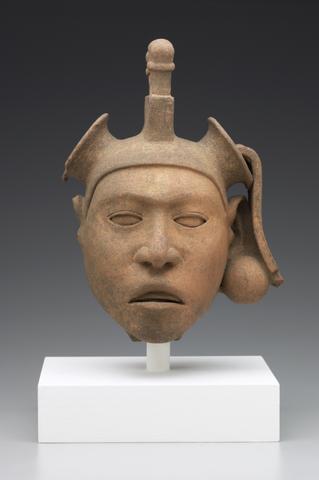
Head of Xochipilli-Macuilxochitl, God of Pleasure, Games and Music
ca. 1500
As the Aztec Empire expanded outward in all directions from its capital at Tenochtitlán, imperial artists appropriated the art of vanquished peoples, incorporating captured styles and media into images of Aztec historical figures and deities. With the incursion into Veracruz, artisans adopted the local tradition of large-scale ceramic sculptures. This highly naturalistic ceramic head, with almond-shaped eyes and a slightly open mouth, once belonged to a full-figure sculpture; the figure would have been represented either in a seated or standing position. The center of the headdress, originally consisting of five vertical stalks (only three remain), is thought to symbolize the crest of a feathered eagle, marking this as the head of Xochipilli-Macuilxochitl, deity of music, flowers, song, and games.
Audio Guides
Andrew Turner, Scholar
View transcript
My name is Andrew Turner, and I've been working as a postdoctoral associate in the Art of the Ancient Americas through a joint appointment in both the Yale University Art Gallery and the Art History Department.
This is the head of a deity that we call Xochipilli, whose name means "the flower prince" in Nahuatl language, which is the language that was spoken by the Aztecs and other groups in Central Mexico prior to the arrival of the Spanish. Still today many people speak the Nahuatl language as well.
This deity, Xochipilli, has a really complex set of symbolism associated with him. This guy's usually associated with the dawning sun, or the newly born sun, in the East. Basically as the sun moves throughout the sky during the day, it ages. It's born as a beautiful youth in the morning, it's a kind of powerful warrior at midday, it grows old and dies at nighttime, and it makes an underworld journey and is then born again in the morning in the East.
Ancient religious practice in Mesoamerica usually engaged multiple senses. One of those senses that's really integral is smell, so usually that means incense in Mesoamerica. They would burn something called copal, which is the sap of a particular type of tree. And it's actually pretty similar to the incense that you'd smell in a Catholic mass. The incense would've been burned inside the body. And, if you notice, his mouth is slightly open; the smoke would've probably poured out of the mouth and that would've been basically how the deity communicates with somebody.
- Medium
-
Ceramic
- Dimensions
-
11 × 8 3/8 × 6 11/16 in. (27.9 × 21.3 × 17 cm)
- Credit Line
-
Gift from the Estate of Alice M. Kaplan
- Accession Number
-
2001.83.1
- Geography
- Culture
- Period
- Classification
- Disclaimer
-
Note: This electronic record was created from historic documentation that does not necessarily reflect the Yale University Art Gallery’s complete or current knowledge about the object. Review and updating of records is ongoing.
Provenance
Provenance
Reportedly excavated in November 1964 at Tres Zapotes, Veracruz; Walter Randel Collection, New York (1965);The Alice M. Kaplan CollectionBibliography
- Art for Yale: Collecting for a New Century, exh. cat. (New Haven, Conn.: Yale University Art Gallery, 2007), 190, 183–84, pl. 175, ill.
- Felipe Solis, ed., El Imperio Azteca: Obras de la exposicion, Spanish ed., exh. cat. (Bilbao, Spain: Guggenheim Museum Bilbao, 2005), 15, no. 17
- Felipe Solis, ed., The Aztec Empire: Catalogue of the Exhibition, exh. cat. (New York: Guggenheim Museum Publications, 2004), 72, no. 331, pl. 176
- Felipe Solis, ed., The Aztec Empire, Curated by Felipe Solis, exh. cat. (New York: Solomon R. Guggenheim Museum, 2004), 305, fig. 176
- "Acquisitions 2001," Yale University Art Gallery Bulletin (2002), 128, ill.
- Linda Bantel, The Alice M. Kaplan Collection, exh. cat. (New York: Columbia University Press, 1981), 48–49, fig. 17
- Elizabeth Kennedy Easby and John F. Scott, Before Cortés, Sculpture of Middle America: A Centennial Exhibition at the Metropolitan Museum of Art from September 30, 1970 through January 3, 1971, exh. cat. (New York: The Metropolitan Museum of Art, 1970), 298, no. 276, ill.
- Julie Jones, Precolumbian Art in New York: Selections from Private Collections, exh. cat. (New York: Museum of Primitive Art, 1969), n.p., no. 93, ill.
- Pre-Columbian Art of Latin America, exh. cat. (Ithaca, N.Y.: Andrew Dickson White Museum of Art, Cornell University, 1966), 28, fig. 65
Object copyright
Additional information
Object/Work type
Technical metadata and APIs
- IIIF
-
The International Image Interoperability Framework, or IIIF, is an open standard for delivering high-quality, attributed digital objects online at scale. Visit iiif.io to learn more
- Linked Art
-
Linked Art is a Community working together to create a shared Model based on Linked Open Data to describe Art.