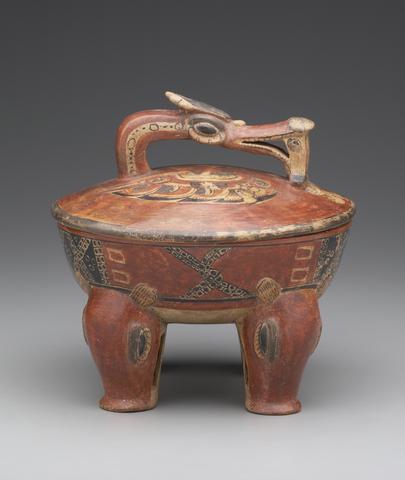
Lidded Vessel with Peccaries, Bird, and Fish
A.D. 300–400
Decoration in paint and modeled clay covers all available space on this lidded bowl, created by a Maya artist in about A.D. 250–400. The handle applied to the lid of the vessel is formed by the arching neck and head of a bird pulling a fish into its mouth; the bodies of both the bird and the fish are painted on the surface of the lid in tan, red, and black. The body of the vessel features a variety of geometric designs painted in black and white, set against a red background. The legs of the vessel are modeled peccary heads, their snouts down, eyes painted in, and mouths indicated by slits, into which ceramic beads were inserted to create a rattle effect.
Audio Guides
Andrew Turner, Scholar
View transcript
My name is Andrew Turner, and I've been working as a postdoctoral associate in the Art of the Ancient Americas through a joint appointment in both the Yale University Art Gallery and the Art History Department.
We're looking at a four-legged vessel that has legs that are the heads of down-turned peccaries, which is a type of wild pig. The upper level shows a bird, which is probably something like a fishing bird, like a cormorant, that's actually pulling a fish out of the water.
It's made out of clay. It's painted with a thin diluted clay with pigments suspended in it, called slip. And then it's highly burnished or polished by smoothing it out with a smooth stone. So it almost gives the effect of being glazed, but it's actually not a true glaze. And all of the pigments have to be mineral-based because organic pigments don't survive during the firing process. They didn't really use kilns the way we think of today. They fired all their ceramics in pits. We don't really know a lot about workshop arrangements, and in fact, even a workshop archeologically is pretty rare to find in the Maya region.
However, we do know that, at later times, making fine ceramics like this was a high-status occupation. And in fact, we have another vessel here in the Gallery that's on display. It's got flowers on it, and it's got an inscription around the rim that said it was made by the nephew of a particularly important Maya city called Naranjo. So we do know that this was actually something that was carried out by—maybe not the king and queen themselves—but maybe relatives of the families. So we think of this kind of high-status artwork as being very useful for these rulers that want to help forge alliances by giving gifts of nice textiles and ceramics and maybe even stone sculpture. But we also think of the knowledge needed to make this sort of symbolic imagery and also the knowledge required to make hieroglyphic inscriptions. This is probably something that you would've had to have been highly schooled in, and you'd probably be somebody from an elite family.
- Medium
-
Ceramic with pigment
- Dimensions
-
10 3/4 × 10 3/4 in. (27.305 × 27.305 cm)
- Credit Line
-
Gift of Peggy and Richard M. Danziger, LL.B. 1963
- Accession Number
-
2001.82.1a-b
- Culture
- Period
- Classification
- Disclaimer
-
Note: This electronic record was created from historic documentation that does not necessarily reflect the Yale University Art Gallery’s complete or current knowledge about the object. Review and updating of records is ongoing.
Provenance
Provenance
Peggy Danziger and Richard M. Danziger, New York, by 1988 (on loan to the Yale University Art Gallery, New Haven, Conn., 1988–2001); given to the Yale University Art Gallery, New Haven, Conn., 2001Bibliography
- Mary E. Miller et al., Fiery Pool: The Maya and the Mythic Sea, eds. Daniel Finamore and Stephen D. Houston, exh. cat. (New Haven, Conn.: Peabody Essex Museum, 2010), 50, no. 5, ill.
- Art for Yale: Collecting for a New Century, exh. cat. (New Haven, Conn.: Yale University Art Gallery, 2007), 191, 384, pl. 176
- Virginia M. Fields and Dorie Reents-Budet, Lords of Creation: The Origins of Sacred Maya Kingship, exh. cat. (London: Scala, 2005), 128–29, no. 33, ill.
- "Acquisitions 2001," Yale University Art Gallery Bulletin (2002), 111, 128, ill.
- Mary E. Miller, "Precolumbian Art of Mexico and Central America at the Yale University Art Gallery," Yale University Art Gallery Bulletin (1995–96), 18, fig. 1
Object copyright
Additional information
Subject
Technical metadata and APIs
- IIIF
-
The International Image Interoperability Framework, or IIIF, is an open standard for delivering high-quality, attributed digital objects online at scale. Visit iiif.io to learn more
- Linked Art
-
Linked Art is a Community working together to create a shared Model based on Linked Open Data to describe Art.