1769

American Decorative Arts

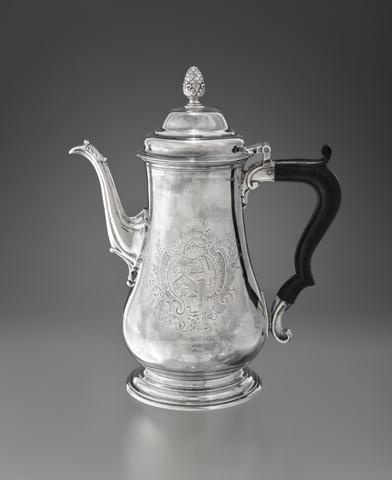
On March 4, 1769, Epes Sargent II ordered this coffeepot from the Boston silversmith Paul Revere. Their interaction is recorded in one of Revere’s daybooks: Sargent supplied most of the silver, and Revere charged him four pounds for making the pot, sixteen shillings for adding the engraving, and four pence for sourcing and attaching the wooden handle. Aside from being particularly well documented, this coffeepot is one of the few pieces of colonial silver to retain its original handle. The swelled belly, scrolling spout and handle, and stepped lid demonstrate Revere’s growing knowledge of the exuberant rococo style that was newly fashionable among Boston’s elite. The masterfully engraved arms, surrounded by an asymmetrical cartouche, represent both the Sargent and Osborne families. Epes Sargent II was a merchant based in Gloucester, Massachusetts, and married to Catherine Osborne, the daughter of John Osborne of Boston. Impaled arms, which combine two families’ arms side by side in a single design, are rare in American silver, and their use on this coffeepot suggests that Osborne brought considerable means to the marriage.

Audio Guides

Patricia E. Kane, Curator

0:00 0:00
View transcript

I'm Patricia Kane. I am the Friends of American Arts Curator of American Decorative Arts.

We're looking at a silver coffeepot by Paul Revere, who's probably America's most famous silversmith—and that's really because of his activities in the American Revolution. I think most people know about his midnight ride, in which he set out from Boston to warn the residents of Lexington and Concord that the British regulars were marching toward them. That has really captured people's imagination. So if you ask the average American, "Who's our most famous silversmith?," if they know at all any silversmith's names, they're apt to come up with Paul Revere.

He worked in Boston from 1754 into the early nineteenth century. There were many aspects of his life that captured the American experience. He was the son of an immigrant. His father came from France in the early eighteenth century and was apprenticed to a Boston silversmith. When he died in 1754 in Boston, his son Paul, Jr., took over the shop and began making objects like this coffeepot.

It really is a beautiful example of the rococo style in Boston. By rococo, I mean the use of asymmetry in its design: the way it catches the light from the pineapple finial at the top, which breaks up the light into little gleaming glimmering bits, to its spout that has little sea scrolls and shell carving on it, to its handle that has this wonderful sort of spur at the top, and then to the side of the object, which has this magnificent engraved coat of arms.

And there's a number of things that are quite rare about this coffeepot. It had been owned in the family for whom it was made and descended in that family until just recently, when the Art Gallery was able to buy it from family members.

It survives with its original handle, which is quite rare in American silver. The handle is ebonized to look like ebony. Just notice how, from that spur at the top of the handle, if you follow the line that goes toward the coffee pot, that line is then picked up in the bezel (that is the little silver socket that joins the handle to the body) by another line that just carries out that same sort of swooping curve. When handles are original, as this one is, you see those subtleties that the silversmith and the carver who fabricated the handle for him thought about and worked out in advance.

So the family or the people for whom this was made was Epes Sargent. He was a merchant in Gloucester, Massachusetts, which is a town on the coast, north of Boston. He had married a woman, Catherine Osborne, in 1745, and she was from a Boston family. The merchants were really the wealthy elite of colonial Massachusetts society. Many of them had these "aristocratic aspirations," I'll call them. The use of their family arms in the engraving on the side of the pot is indicative of that. In other words, the British aristocracy had coats of arms that historically had identified the family, and many Americans imitated that practice to associate themselves with the British elite.

If you look closely at the arms on the pot, you'll see that at the center of the cartouche—that is, the flowers and shells and sea scrolls that surround the central design—to the left you see three little leaping dolphins, and those are the arms of Epes Sargent. To the right of the center design, one sees a large cross set in a field of four quadrants, and those are Catherine Osborne's family arms. It is really rare in American silver where you get both the husband's and the wife's arms represented on a cartouche such as this. It implies to us that Catherine probably was wealthy in her own right. Further evidence of that is that when when her husband died in 1779, he died, what in those days was called, insolvent or basically bankrupt. But when the estate was settled, she received her dower and was granted a mansion house without buildings and a pew in the great meeting house so that she could continue to live the sort of aristocratic life that she was used to.

Medium

Silver

Dimensions

9 7/8 × 8 1/2 × 4 3/4 in. (25.08 × 21.59 × 12.07 cm), 28 oz., 10 dwt. (887 gm)

Credit Line

Purchased with gifts from Stephen S. Lash, B.A. 1962, and the Estate of Dr. Joseph V. and Eleanor M. Medeiros and with the Josephine Setze Fund for the John Marshall Phillips Collection; Friends of American Arts Acquisition Fund; Leonard C. Hanna, Jr., Class of 1913, Fund; Peter B. Cooper, B.A. 1960, LL.B. 1964, M.U.S. 1965, and Field C. McIntyre American Decorative Arts Acquisition Fund; Mr. and Mrs. Frank J. Coyle, LL.B. 1943, Fund; Lisa Koenigsberg, M.A. 1981, M.Phil. 1984, Ph.D. 1987, and David Becker, B.A. 1979, Fund; and Friends of American Arts Decorative Arts Acquisitions Fund

Accession Number

2016.158.1

Geography
Culture
Period
Classification
Disclaimer

Note: This electronic record was created from historic documentation that does not necessarily reflect the Yale University Art Gallery’s complete or current knowledge about the object. Review and updating of records is ongoing.

Provenance

Provenance

Epes Sargent, Jr. (1721–1779) and Catherine Osborne Sargent (1722- 1788), Gloucester, Massachusetts; by descent to their son Epes Sargent III (1748–1822), Gloucester, Massachusetts, then New Hampshire, then Boston; by descent to his daughter Mrs. John Dixwell (nee Esther Sargent, 1776–1865), Boston; by descent to her son Epes Sargent Dixwell (1807–1894), Cambridge, Massachusetts; by descent to his daughter Mrs. Oliver Wendell Holmes, Jr. (née Fanny Bowditch Dixwell, 1840–1929), Boston and Washington, D.C.; by descent to her sister Mrs. George Wigglesworth (née Mary Catherine Dixwell, 1855–1951) Boston; by descent to her daughter Mrs. Lloyd Thornton Brown (née Marian Epes Wigglesworth, 1884–1973), Milton, Massachusetts; by descent to her daughter Ruth Brown; by sale to her brother Thornton Brown (1913–2000) Milton, Massachusetts; by gift to the Brown Family Nominee Trust, 1996
Bibliography
  • American Art: Selections from the Yale University Art Gallery (New Haven, Conn.: Yale University Art Gallery, 2023), 70–71, no. 19, ill.
  • Patricia E. Kane, "A Coffeepot by Paul Revere," Yale University Art Gallery Magazine (Fall 2017), 14, ill.
Object copyright
Additional information

Object/Work type

Marks

".REVERE" stamped on body near upper handle socket and on underside

Technical metadata and APIs

IIIF

Open in Mirador

View IIIF manifest

The International Image Interoperability Framework, or IIIF, is an open standard for delivering high-quality, attributed digital objects online at scale. Visit iiif.io to learn more

Linked Art

API response for this object

Linked Art is a Community working together to create a shared Model based on Linked Open Data to describe Art.