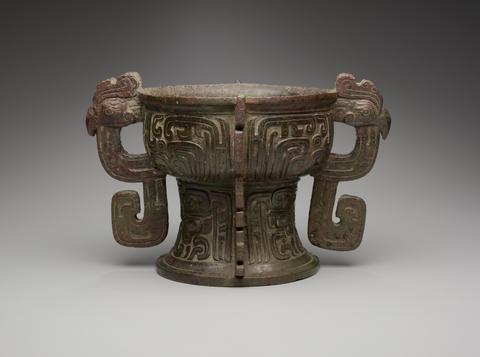
Serving Vessel (Gui)
854 B.C.E.
The long, remarkably preserved 104-character inscription on the interior indicates that this bronze vessel was cast as part of a set, which was produced during property negotiations between an individual called Diao Sheng and some of his patrilineal relatives after the death of his father. Diao is a reference to his mother’s family. The sweeping serpentine forms on the surface of the bronze are typical of vessels cast in Shaanxi Province, as are the phoenix-headed handles.
Audio Guides
Valerie Henriquez, Student
View transcript
Valerie Henriquez, TC ’27
Three thousand years ago, bronzes like this gui vessel played a central role in both daily life and the afterlife of the elite in China. This serving vessel dates to the second half of the Western Zhou dynasty, around 800 B.C.E. It features an intricate serpentine design. This type of vessel was used throughout the Shang and Zhou dynasties. It features a rounded base, handles, and animal motifs. Such vessels were made to hold ritual food offerings, such as grain, and placed in ancestral tombs.
You can see that the wide-mouthed bowl sits on a cylindrical base that flares outward, giving it a balanced form. The gui contains two handles on its sides. The handles take the shape of birds’ heads, with long beaks and feathered crests. From the side, the vessel has two flamelike ridges on the upper portion of the bowl and two serpentlike designs on the lower half. The bowl’s exterior is also decorated with two symmetrical circles that look like the eyes of an animal. The left and right sides carry symmetrical spirals and cane-shaped designs.
Beyond its elegant form, a 104-character inscription on the inside of the bowl dates the vessel to around 800 B.C.E and suggests that this vessel was cast as a set. It was created during property negotiations involving an elite man, Diao Sheng, and his relatives following his father’s death. The text records a lawsuit in which the family’s matriarch decided the dispute. Such inscriptions emphasize Zhou-dynasty values of respect, order, and hierarchy, showcasing the importance of ancestor worship.
Through its zoomorphic motifs, its form, and its enduring bronze material, this vessel gives us a glimpse into Zhou-dynasty understandings of spirituality and the afterlife. The placement of vessels like this one in tombs also highlights the importance of ancestors and the belief in a life beyond death. During the Zhou dynasty, elites invited spirits of deceased ancestors to ceremonial meals, treating them as if they still required food and drink. This vessel created a material bridge between the living and the dead. Bronze is more durable than perishable materials like wood. To the Zhou elite, vessels like this one symbolized a lasting connection between the living and the spirits of their ancestors.
- Medium
-
Bronze
- Dimensions
-
8 1/4 × 8 5/8 in. (21 × 21.9 cm)
- Credit Line
-
Hobart and Edward Small Moore Memorial Collection, Gift of Mrs. William H. Moore
- Accession Number
-
1954.26.2
- Geography
-
Associated place: China
- Culture
- Classification
- Disclaimer
-
Note: This electronic record was created from historic documentation that does not necessarily reflect the Yale University Art Gallery’s complete or current knowledge about the object. Review and updating of records is ongoing.
Provenance
Provenance
C. T. Loo (Ching Tsai Loo, dealer, 1880–1957), New York; Mrs. William H. Moore (1858–1955), New York by 1954; given to the Yale University Art Gallery, New Haven, Conn., 1954Bibliography
- Elise K. Kenney, ed., Handbook of the Collections: Yale University Art Gallery (New Haven, Conn.: Yale University Art Gallery, 1992), 285, ill.
- George J. Lee, Selected Far Eastern Art in the Yale University Art Gallery (New Haven, Conn.: Yale University Press, 1970), 121–122, no. 237, ill.
- Phyllis Ackerman, Ritual Bronzes of Ancient China (New York: The Dryden Press, 1945), pl. 33
- Max Loehr, "Beitrage zur Chronologie der Älteren Chinesischen Bronzen," Ostasiatische Zeitschrift 1 (1936), NF 12, Helf 1/2, Tafel 5, Abb. 14
- Tch'ou To-yi and Paul Pelliot, Bronzes antiques de la Chine appartenant a C. T. Loo et cie (Paris: G. Van Oest, 1924), pl.10
Object copyright
Additional information
Inscriptions
104 character inscription: "In the fifth year, the first month, on the day of chi-ch'ou, Tiao Chen, having a business affair, came to Chao (Shao) to transact it. I presented a "hu" vase to the Chin (Tsin) family, remarking, "The order of the Seigneur (Lord of Chao) was that I should check (up) the fields belonging to the subjects of the prince which are near the walls, as their boundaries appeared to be very erroneous. I Po (my man) has assisted me in these verifications. Where (it was stated) that you had encroached by three (tenths) you had only encroached by two (tenths); where (it stated) you had encroached by two (tenths) you had only encraoched by one (tenths). I am touched by the great favor of the seigneur (Lord of Chao) and I thank the Chin family for their gift of a piece of silk, and a huang pendant. Shao Po-hu said that because I was respectful I would not refuse what was in the agreement with the orders of his father and mother; also he hoped that I would come back again as his father and mother consider me as a conscientious gentleman."Technical metadata and APIs
- IIIF
-
The International Image Interoperability Framework, or IIIF, is an open standard for delivering high-quality, attributed digital objects online at scale. Visit iiif.io to learn more
- Linked Art
-
Linked Art is a Community working together to create a shared Model based on Linked Open Data to describe Art.