Virgin and Child, known as the Madonna del Libro
Artist: Pontormo (Jacopo Carucci) (Italian, 1494–1557)
ca. 1545–46
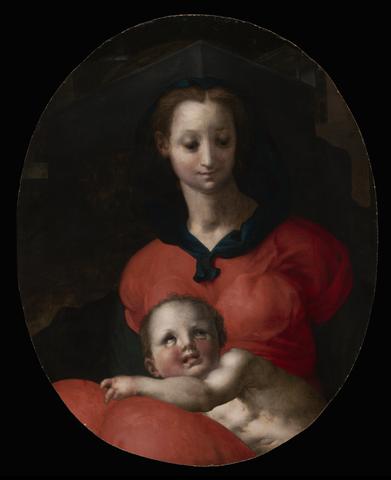
Pontormo was the foremost painter in Florence of the generation following Leonardo, Raphael, and Michelangelo, and the preferred artist of the Medici dukes. This painting is the only surviving fragment of his most famous composition (the complete image is recorded in no fewer than twenty-five sixteenth-century copies) and the latest known work from the artist’s hand. Left incomplete in Pontormo’s studio at the time of his death, it was probably cut centuries later to its present size and shape.
Audio Guides
Laurence Kanter, Curator
View transcript
This is Laurence Kanter. I'm Chief Curator and Lionel Goldfrank III Curator of European Art at the Yale University Art Gallery.
This is a fragment of a painting, although it's large, and it looks more or less complete. It's a fragment of a famous painting by Jacopo Pontormo, who was the greatest of the Florentine painters in the generation following Michelangelo and Leonardo. In fact, he was a very close friend of Michelangelo, who entrusted his drawings to Pontormo to render into paintings.
This painting is known in at least twenty-five, if not thirty, contemporary copies. It is the most copied painting of the entire sixteenth century. Scholars have always been puzzled why one picture should have been copied so often when no others that we know exist in more than three or four replicas. Scholars were also puzzled about which of those many known versions might be the original. No one had ever agreed on it until this one appeared and is now clearly what remains of the original from which the other copies were made.
It's a painting that was left in Pontormo's studio at his death and was discovered there when he died, incomplete. And it became the subject of a lawsuit, ultimately won by his pupil Bronzino, a famous painter in his own right. Bronzino, it appears, used this painting as a teaching piece. All of his pupils had to execute copies of it, and this is why so many copies survive. All of the known copies complete the incomplete parts of this picture—that crumbled brown area to the left of the Virgin's headdress, for example, or what looks now like a building above her. In all the copies, those areas are finished in some different imaginative way by each of the pupils.
It's very exciting to have a picture like this here, not only as a remarkably rare and wonderful thing to have found, but also, because it's incomplete, you can see without the aid of high technology how the artist made his pictures. You can actually see with your naked eye the drawing of, for example, the Christ Child's arm and shoulder. You can see the earliest layers of paint just blocking in the shadowy area on his ribcage or the lights on the front. The Virgin's dress is fully painted but does not have its final layers of glaze on it. Whereas her headscarf is totally complete, her head, you see, is also in various different stages of being worked up or left raw.
Alongside the label, you'll see we've put an image of one of the full-scale copies. What's missing is the rest of the Virgin, her knees tucked up so improbably in front of her. And in the background at the right, now cut off, were two or three other figures climbing a set of steps into a city gate. We have no idea who those figures are. We don't know if there's a story behind the picture. Pontormo was a very eccentric artist, and we don't know if this picture had a patron or if it was just made by the artist, as it were, for his own pleasure. All we know is that, when it was found in his studio, it was described by contemporaries as a Virgin and Child with other figures. And it's the only painting known by Pontormo that has other figures alongside the Virgin and Child.
For art students, this work is a gold mine to study. For those of us who are not art students but just lovers of art, it's also a gold mine.
- Medium
-
Oil on panel
- Dimensions
-
unframed: 31 3/4 × 25 1/4 in. (80.7 × 64.1 cm)
- Credit Line
-
Maitland F. Griggs, B.A. 1896, Fund
- Accession Number
-
2006.111.1
- Geography
- Culture
- Period
- Classification
- Disclaimer
-
Note: This electronic record was created from historic documentation that does not necessarily reflect the Yale University Art Gallery’s complete or current knowledge about the object. Review and updating of records is ongoing.
Provenance
Provenance
Possibly identical with a painting found in Pontormo's house at his death (January 1, 1557) and sold out of his estate in 1559 to Alfonso Quistelli, fiscal agent of Cosimo I de' Medici, Grand duke of Tuscany; sold by Quistelli in 1559 to Alessandro Allori, acting on behalf of Agnolo Bronzino; sold by Bronzino and Allori to Piero Salviati, Florence, 1559; Grand duke Cosimo de' Medici, 1564. Private collection, France (sale, Jean-Claude Anaf & Associe, Lyon, Lot 215, March 25, 2001). Matteo and Marco Grassi, Paris and New York; Sotheby's, New York, January 23, 2003 (BI)Bibliography
- Art for Yale: Collecting for a New Century, exh. cat. (New Haven, Conn.: Yale University Art Gallery, 2007), 222, 394, pl. 209
Object copyright
Additional information
Object/Work type
Subject
Technical metadata and APIs
- IIIF
-
The International Image Interoperability Framework, or IIIF, is an open standard for delivering high-quality, attributed digital objects online at scale. Visit iiif.io to learn more
- Linked Art
-
Linked Art is a Community working together to create a shared Model based on Linked Open Data to describe Art.