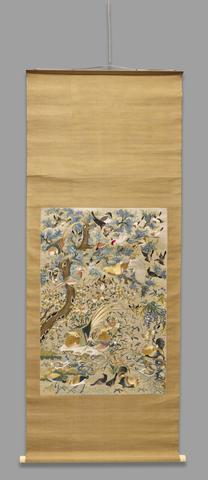
One Hundred Birds

Artist: Unknown

Audio Guides

Denise Patry Leidy, Curator

0:00 0:00
View transcript

Hi, I'm Denise Leidy. I'm the Ruth ad Bruce Dayton Curator of Asian Art at the Yale University Art Gallery.

This really engaging embroidery of birds was made in China, probably around the nineteenth century, and it tells us an interesting story about the relationship between painting and textiles in China. The background for this is made of silk in a satin weave, which means that it's very glossy on the outside. And all of the details were embroidered using silk thread. Silk—which is a natural fiber and comes from silkworms—is very strong and very tensile. Therefore, it allows people to make very elegant, very carefully detailed embroideries.

As a result, as early as the twelfth century, sometimes there are interesting overlaps between painting and the textile arts in China. And you can see this here, because this embroidery is actually mounted in a way that you would mount a Chinese painting. It's in a vertical format mounted with additional cloth, and it is something called a hanging scroll. It tells us a great deal about the incredibly rich and nuanced visual culture of China.

One of the things that one finds in Chinese art, both two- and three-dimensional, is an awareness of the passing of the seasons. At the moment, we are looking at summer. You can see this by the lushness of the foliage in this embroidery and also via details such as the peonies, which are symbols of wealth in Chinese culture but also flowers that signify summer.

All of the birds that one sees in this embroidery are shown in pairs, and the pairs themselves often have additional meanings. For example, the cranes in the lower left-hand corner signify longevity, while the pheasants that dominate the central part of the embroidery are often understood as bringing wealth and good wishes. Additionally, all of the birds in this embroidery are paired, so they're statements about male and female and balance and unity in the cosmos.

Even though there are not technically one hundred birds in this embroidery, the theme of the hundred birds has a long history in China. And at least as early as the fifteenth century, it serves as a symbol for good government. So whatever the initial use of this wonderful embroidery was, it wishes us a happy summer, good wishes, and reminds us of the importance of good government.

Medium

Hanging scroll; satin with silk embroidery, ivory rollers

Dimensions

43 × 29 in. (109.2 × 73.7 cm)

Credit Line

Hobart and Edward Small Moore Memorial Collection, Gift of Mrs. William H. Moore

Accession Number

1937.5600

Geography
Culture
Classification
Disclaimer

Note: This electronic record was created from historic documentation that does not necessarily reflect the Yale University Art Gallery’s complete or current knowledge about the object. Review and updating of records is ongoing.

Provenance

Provenance

Purchased in China by Mrs. William H. Moore (Ada Small Moore, 1858–1955), New York by 1937; given to the Yale University Art Gallery, New Haven, Conn., 1937
Bibliography
  • James Prosek and Edith Devaney, James Prosek: Art, Artifact, Artifice, exh. cat. (New Haven, Conn.: Yale University Art Gallery, 2020), 104, pl. 82
Object copyright
Additional information

Object/Work type

Technical metadata and APIs

IIIF

Open in Mirador

View IIIF manifest

The International Image Interoperability Framework, or IIIF, is an open standard for delivering high-quality, attributed digital objects online at scale. Visit iiif.io to learn more

Linked Art

API response for this object

Linked Art is a Community working together to create a shared Model based on Linked Open Data to describe Art.